For remote workers who freeze on camera
You don't have to feel calm to get through the call. You just need a system for the moment it hits.
The breathing apps work in a quiet room. None of them help when your turn is three names away and your finger is hovering over unmute. The 3-Window Panic-Safe Method™ is built for that exact moment — before, during, and after the call.
- Walk into your next meeting with your heart rate already lower — in two minutes flat.
- Keep your voice and your clarity while the spike runs — discreetly, on camera, mid-sentence.
- Stop carrying the shake into the rest of your workday.
But you already know the quiet-room stuff doesn't help. So let's talk about the moment that actually does the damage.
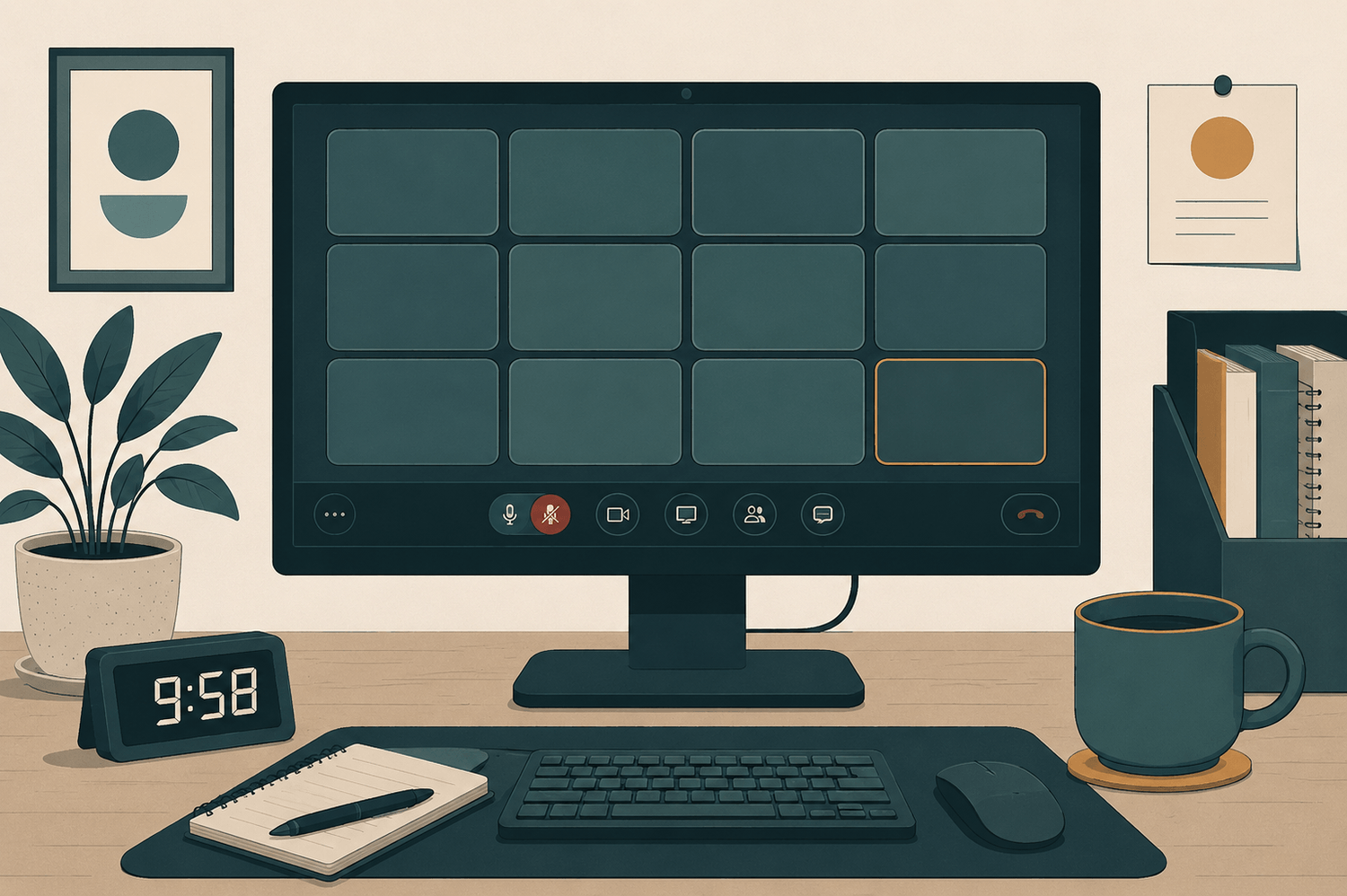
It's 9:58. The meeting starts in two minutes, and your body already knows.
It's 9:58. You're at your desk, the call link open in the tab. Your turn to give the update is somewhere in the first ten minutes. Your heart is already going. Your finger is resting on the unmute button like it's the edge of a diving board — and you haven't said a single word yet.
And it isn't just this meeting. It's the all-hands. The one-on-one. The "quick sync" that's never quick. The presentation you rehearsed four times and still dreaded. Somewhere along the way, the calendar stopped being a schedule and started being a list of things to survive.
And the thing you'd never say out loud: I'm good at this job. So why does a thirty-minute call leave me shaking like I just did something dangerous?
Here's what nobody tells you about that question — the real cost isn't the bad call. It's what another year of them quietly takes from you.
The part that doesn't show up on camera
It was never really about one meeting.
You start arranging your whole workday around which meetings you can survive. You decline the camera. You dread Mondays by Sunday afternoon. You lose the hour before every call to pure anticipation. That's not a bad day. That's a year of your life spent bracing — finger over unmute, again and again.
Quietly, you become "the quiet one." The one who "prefers to follow up in writing." The one who keeps the camera off. You're still capable — but at work you've shrunk into the smallest version of yourself, watching your own face in the corner of the grid and hoping no one calls on you.
And the role that needs you visible, the promotion that needs you to present — it gets handed to someone who can speak on a call without their body betraying them. Not because they're better at the work. Because the words came out when it counted, and yours didn't.
It's not one bad call. It's the slow narrowing of what you'll let yourself do — meeting by meeting — until "I just work better behind the scenes" becomes the whole story you tell about yourself.
If any of that landed a little too hard, read the next part carefully. Because the worst part of this is feeling like you're the only one it happens to. You're not.
Read this and tell me it isn't you
You're not weak. You're not failing. Your nervous system is just doing its job at the worst possible time.
If you nodded at even three of these, you're not broken and you're not alone — you're exactly who this was built for.
- You rehearse the sentence you're about to say four times in your head — and it still comes out wrong.
- You feel your heart in your throat before you've even hit unmute.
- You watch your own face in the corner of the grid instead of listening, scanning for the second the panic shows.
- You schedule your hardest work around your meetings, not the other way around.
- You've perfected the "sorry, my connection's unstable" excuse for keeping your camera off.
- You say "let me follow up over email" so you don't have to speak live.
- You've left your desk shaking after a call that, on paper, went completely fine.
This isn't a personality flaw, and it isn't a lack of willpower. It's a nervous system doing exactly what it's wired to do under pressure — at the worst possible moment. And a wired response isn't something you're stuck with. It's something you can work with.
See how the three windows work →Which raises the real question — if you're capable and you've genuinely tried, why has nothing actually helped on the call? There's a reason. And it's not you.
Why everything you tried went quiet at the worst moment
Here's the uncomfortable truth: every tool you've been handed was built for the wrong room. The breathing app, the meditation, the "just relax before the call" — all of it was designed to lower anxiety in a quiet room, with your eyes closed, when nothing is happening. None of it was ever built for the one place you actually need it: live, on camera, with your turn three names away. That's not your failure. That's a wrong-tool-for-the-moment problem.
You don't need to eliminate the anxiety to perform. You need a system for the three moments it actually hits.
The 3-Window Panic-Safe Method™
PRIME → HOLD → RESET
PRIME — before
What: a 2-minute body protocol you run in the minutes before the call. Outcome: you walk in with your heart rate already lower. Why: settling your baseline before the trigger means the spike peaks lower — you can't think your way calm once you're already on the cliff.
HOLD — during
What: discreet moves — grounding, micro-scripts, a visible notes structure — you can run on camera, mid-sentence, without anyone noticing. Outcome: your voice holds and your mind stays online while your body does its thing. Why: you stop fighting the panic and keep function instead — the body settles faster when it isn't also fighting you.
RESET — after
What: a short sequence for the minutes after the call. Outcome: you don't drag the shake into the next three hours. Why: closing the stress cycle stops residual activation from stacking, call after call after call.
That's why the unmute button felt like a cliff — you were trying to think your way calm in the one window where thinking only makes it worse.
Clinicians increasingly recognize that what you do in the moments around a stressor can matter as much as the stressor itself.So picture the version of your week where you actually have something to do in each of those three windows.
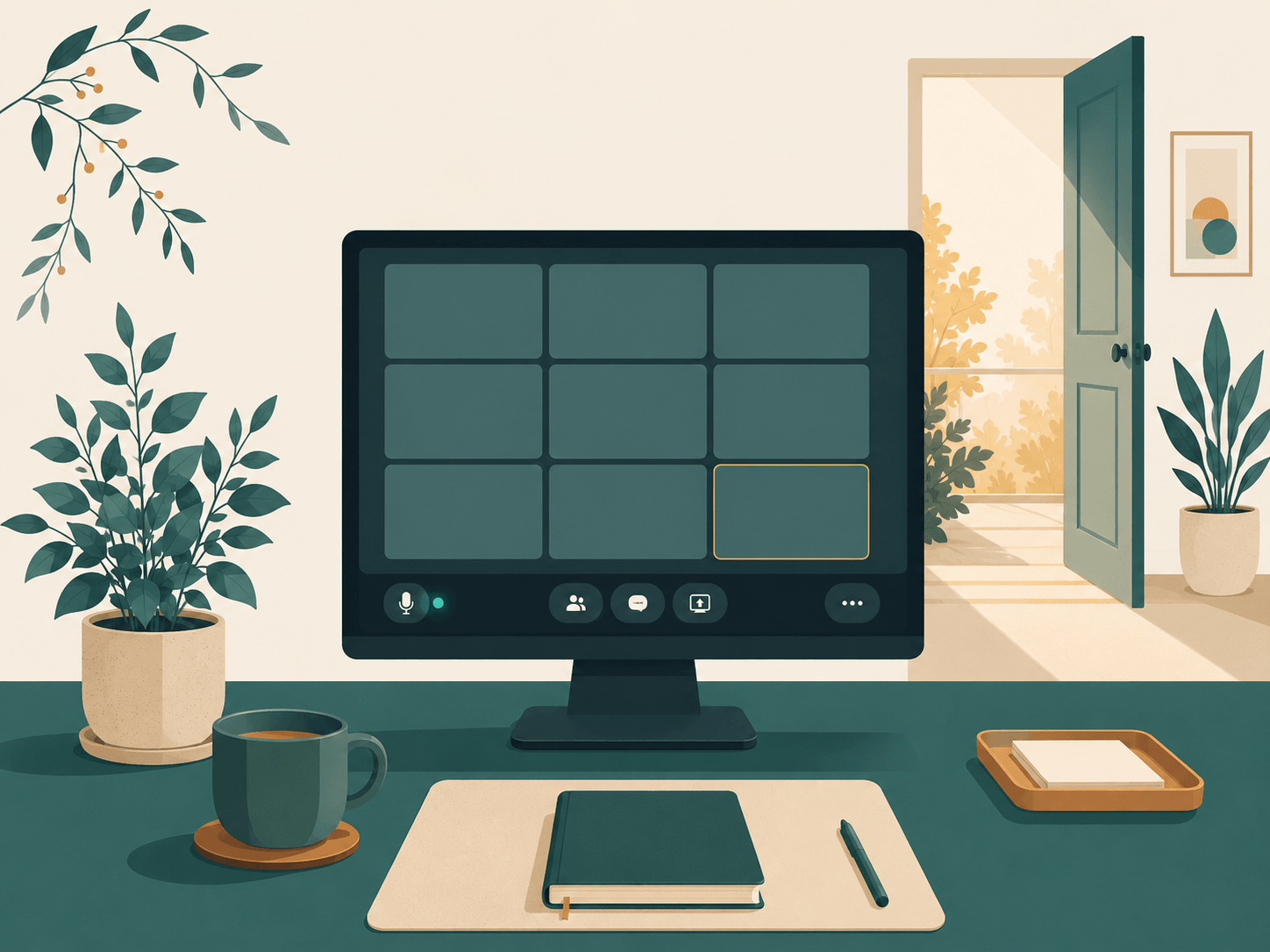
A Tuesday a few weeks from now
Same calendar. Same all-hands. A completely different body.
It's 9:55. The all-hands is in five minutes. You run the two-minute PRIME, set your notes where you can see them, and turn the camera on yourself — and the face in the corner of the grid just looks like you. Your turn comes. You hit unmute. Your voice is yours. The nerves didn't vanish — they're just not the loudest thing in the room anymore. And when the call ends, you close the laptop and go make coffee. The bathroom door stays open.
This isn't a "calm in 7 days" promise. It's what tends to shift in the first week or two of actually using the three windows — call by call, the moment stops owning you.
So here's exactly what you get, and exactly how each piece maps to one of the three windows.
What's inside
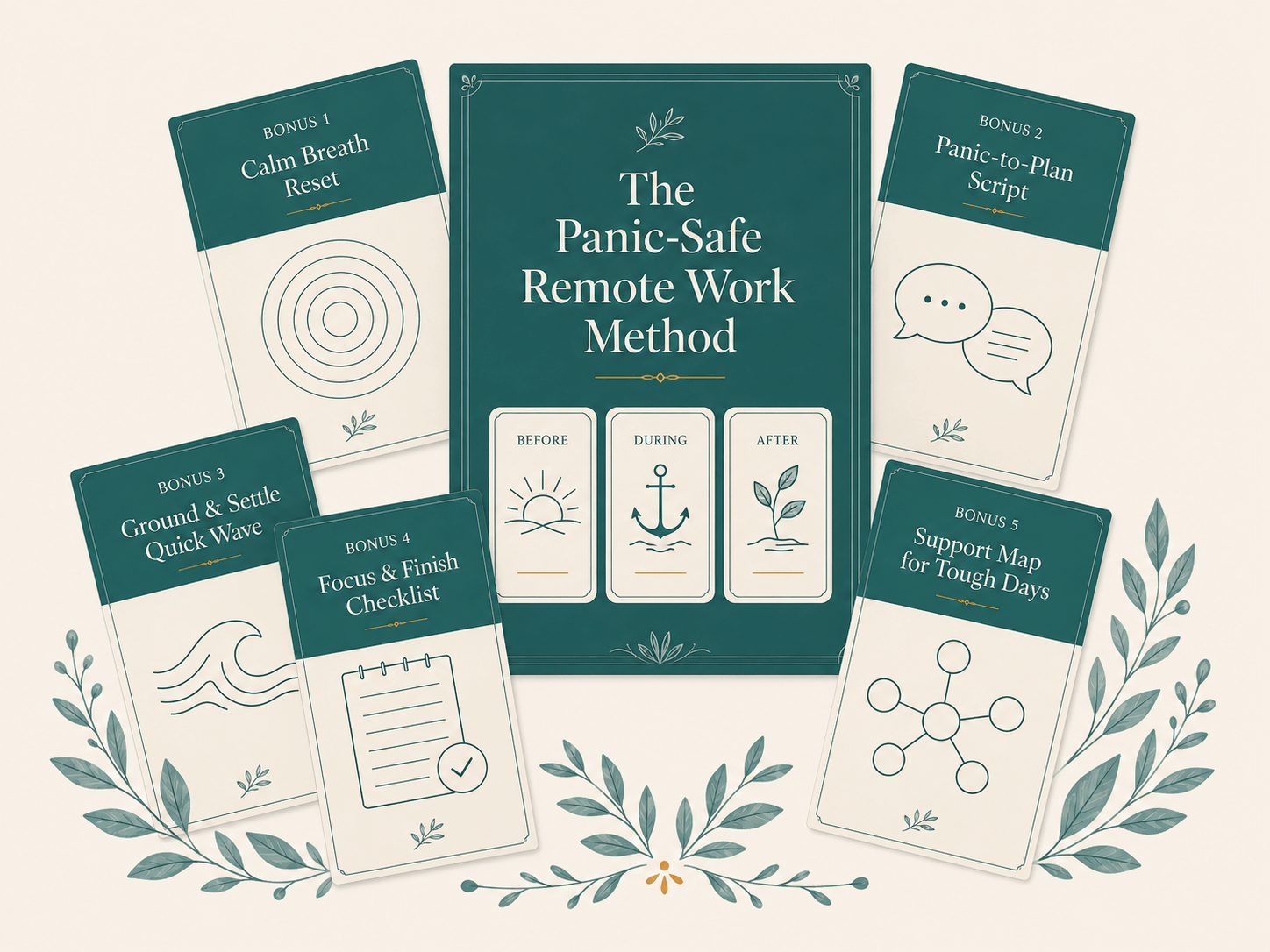
The Panic-Safe Remote Work Method
A practical, ~60–80 page method that takes the three windows and turns them into things you can actually do — on your very next call. No theory you have to master first. No quiet room required.
The Panic-Safe Remote Work Method
- Module 1 — The 3-Window Map: pinpoint exactly where your panic hits, so you stop using the wrong tool at the wrong moment.
- Module 2 — PRIME: the 2-minute pre-call protocol that lowers your starting point before the link even opens.
- Module 3 — HOLD: the discreet on-camera moves that keep your voice and clarity while the spike runs.
- Module 4 — RESET: the after-call sequence that stops panic from stacking across your day.
- Module 5 — Build your own protocol: turn the three windows into a repeatable system for your specific triggers.
And to cover all three windows from minute one, you also get:
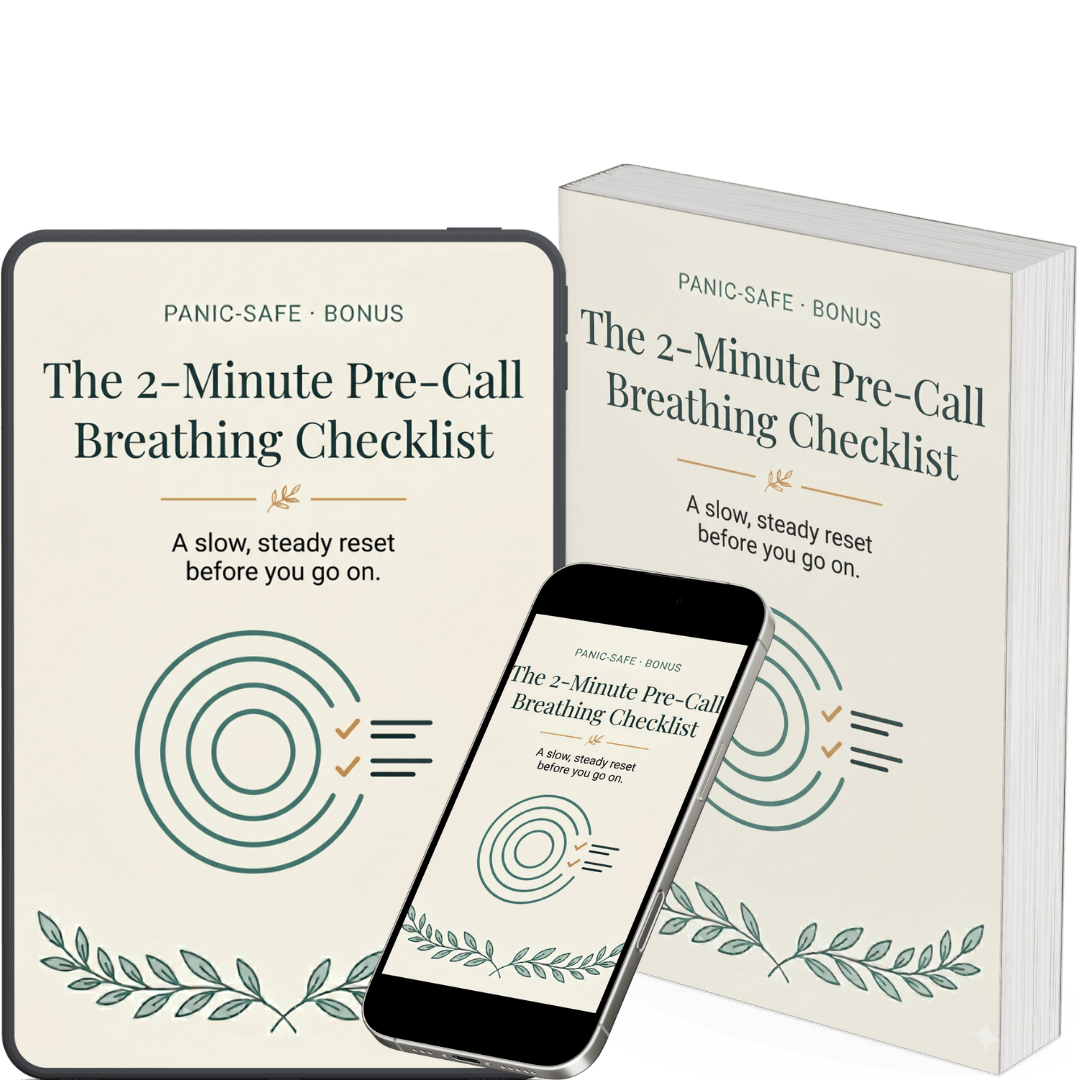
The 2-Minute Pre-Call Breathing Checklist
The exact step-by-step to run right before the call lands, so you don't have to think or improvise when your hands are already shaking. (value $19)
The Silent Grounding Scripts for Zoom Panic
Discreet mental scripts you run while you're on camera, on mute, or mid-conversation. Nobody sees a thing. (value $23)
The After-Call Nervous System Reset
The short checklist for the minutes after a hard call, so you don't carry the shake into the rest of your day. (value $17)
The Zoom Update Safety Notes Template
A fill-in structure for your talking points so blank-mind never leaves you stranded mid-sentence — the notes you can glance at while you're live. (value $19)
The Remote Trigger Map
A simple tool to turn vague dread into a clear map of which situations spike you: camera-on, live improv, feedback, silence, Slack overload. (value $21)
Everything you get today
- The Panic-Safe Remote Work Method$47
- The 2-Minute Pre-Call Breathing Checklist$19
- The Silent Grounding Scripts for Zoom Panic$23
- The After-Call Nervous System Reset$17
- The Zoom Update Safety Notes Template$19
- The Remote Trigger Map$21
- Total value $146 — Today$27
Before you grab it, though — let me be honest about who this is not for.
Let's be honest about fit
This works for a specific person. Make sure that's you.
This is for you if…
- You're genuinely good at your job — it's the live, on-camera moments that hijack you, not the work itself.
- You've already tried "just breathe," the meditation apps, maybe even therapy — and you need something for the actual moment, on the call, not in a quiet room after.
- You keep your camera off and your mute on to hide what your body is doing, and you're done arranging your whole career around it.
- You want something you can use on your very next call — not a months-long program.
This is not for you if…
- You're looking for a way to never feel anxious again. This keeps you functional while it happens; it doesn't erase it.
- You want clinical treatment or a replacement for professional care. This is a practical self-management method — not therapy, not medical advice.
- You won't actually run a two-minute protocol before a call. The windows only work if you use them.
If you're still here, you should know who built this — and why I needed it before anyone else did.

Who's behind this
I built this method because I was the person muting myself on every call to hide the shaking.
I remember the exact call. Quarterly review, my turn to present, and I watched my own face freeze in the corner of the grid while my voice cracked on the second sentence. I typed "sorry, connection's unstable," dropped off — and locked the bathroom door. Then I stood there shaking for ten minutes over a meeting that, on paper, went completely fine.
I'd done all of it. The breathing apps. The meditations. A therapist I couldn't really afford every week. They helped me feel calmer in a quiet room and did absolutely nothing the second a meeting invite landed. So I stopped trying to "fix my anxiety" and started watching when it actually hit. It was never random. It was always one of three moments — the minutes before, the seconds during, the slump after.
So I built something tiny for each window. A two-minute thing to do before. A handful of moves I could run on camera, mid-sentence, with nobody seeing. A short reset for after. I tested them on every call I couldn't get out of, and I kept only what actually held up live.
I won't tell you it made me fearless. It didn't. But I stopped turning my camera off. I started speaking up in the moment instead of "following up over email." And the bathroom door stayed open.
— Nora Whitaker
Which is exactly why I can price this the way I do — because I know what the alternative actually costs.
What it's really worth
Compare it to what another year of this costs you.
A single year of dodged cameras, lost hours of pre-call dread, and the promotion you didn't raise your hand for costs you a lot more than $27. The role you talked yourself out of is the real price — and it's not $27.
- The Panic-Safe Remote Work Method$47
- The 2-Minute Pre-Call Breathing Checklist$19
- The Silent Grounding Scripts for Zoom Panic$23
- The After-Call Nervous System Reset$17
- The Zoom Update Safety Notes Template$19
- The Remote Trigger Map$21
You pay today $27 — you save 82%
Why not just use what you already have?
| The 3-Window Method | Breathing / meditation apps | Therapy | Generic stress ebooks | |
|---|---|---|---|---|
| Built for the live, on-camera moment | Yes | Quiet-room only | Yes, but slow | No |
| Works during the call, not just after | ||||
| Specific to remote-work triggers | Sometimes | |||
| Cost | $27 once | ~$70/yr | $$$ ongoing | ~$20 |
$146$27 today
Get the Method — $27I know there's still a "yeah, but…" running in the back of your mind. Let's say it out loud.
The honest answers
Three things you're probably thinking right now.
"I'm in back-to-back meetings — I don't have time to learn a whole system."
Honest answer: the core of PRIME is two minutes before a call, and HOLD is a few seconds during it. If you have time to dread the meeting, you have time to prime for it. This fits inside the day you already have.
"I've tried everything. My anxiety is just worse than most people's."
I thought that too — for years. But everything you tried was built for the wrong window: the quiet room, after the fact. You didn't fail at this. You were handed the wrong tool for the one moment that actually matters. That's a very different problem, and it has a fix.
"What if I pay $27 and it's just more breathing tips?"
Fair. That's exactly why you get fourteen days to use it on real calls first. If it doesn't change what happens on camera, you email me and get every cent back. The only way to find out is on an actual call — and that part's on me.
Which brings us to the part where the risk stops being yours.
Your risk, handled
Put it on real calls for 14 days. If your camera stays off, you pay nothing.
A 14-Day Money-Back Guarantee — USA. No screenshots, no hoops.
Here's how sure I am: I don't want your $27 if this doesn't change anything on your calls. So I'm taking the risk off your side of the table entirely.
Get the method today. Run PRIME before your meetings. Run HOLD during them. Run RESET after. Give it two weeks of real calls — not a quiet room, real ones.
If you're not staying more functional on camera — if nothing shifts — email me within 14 days and I'll refund every cent. You keep the bonuses. No screenshots, no hoops, no "let me transfer you."
"Use the full method for 14 days. Run the windows on real calls. If you're not staying more functional on camera, email me and I'll refund every cent — no screenshots, no hoops."
If two weeks from now you're still locking the bathroom door after every call, you shouldn't pay for this. That's the deal.
How do I get a refund?
One email within 14 days. That's the whole process.
Do I lose the bonuses if I refund?
No. The bonuses are yours to keep either way.
How fast is it?
Refunds are handled as fast as I can read the email.
— Nora Whitaker
A few last questions people always ask before they start.
Before you decide
The questions you're probably still holding.
Is this therapy or medical advice?
No. It's a practical self-management method for the moments around work calls — not a replacement for professional care, and not a diagnosis. If you're in crisis or struggling beyond work calls, please reach out to a qualified professional.
Will this make my anxiety go away?
That's not the promise. It's built to keep you functional, clear, and credible while it happens — not to erase it.
How fast can I actually use it?
You can run the PRIME window on your very next meeting. There's nothing to master first.
I've tried breathing apps and they didn't help — why is this different?
Because they're built for the quiet room, after the fact. This is built for the live, on-camera window — the one place the others go silent.
Is it discreet? Can I really use it on camera?
Yes. The HOLD moves are designed to be invisible — on camera, on mute, or mid-conversation.
What if it doesn't work for me?
You get 14 days. Run the windows on real calls; if you're not staying more functional on camera, email me and I'll refund every cent — no screenshots, no hoops.
What exactly do I get, and in what format?
The full ~60–80 page method plus 5 bonuses — all digital, instant access after checkout. Read it on any device, before your next call.
You already know the quiet-room stuff doesn't reach the call. The 3-Window Method does — before, during, and after — so the next time your turn is three names away and your finger's on unmute, you've got something to do besides brace. Two minutes from now you could be reading it.
Get the Panic-Safe Method — $27